Inverter repair
We repair frequency converters from a wide variety of manufacturers and power classes – quickly, reliably and cost-effectively. The frequency converter takes over the control of asynchronous and synchronous motors and enables continuous regulation of speed and torque. This allows motors to be used flexibly in drive electronics. Common sources of faults are defective power semiconductors, control boards, power supply units or capacitors. Following a comprehensive diagnosis, we selectively replace only the components that are actually damaged. Upon request, we overhaul the entire device to minimise downtime and extend its service life.
How a frequency inverter works
A frequency converter generates a direct current voltage from the mains frequency. This direct current voltage is then converted into the desired output voltage and frequency.
power components
In order for the frequency converter to perform its function, it requires power components. In the following, we will describe the most important power components of the frequency converter.
Electronic switches
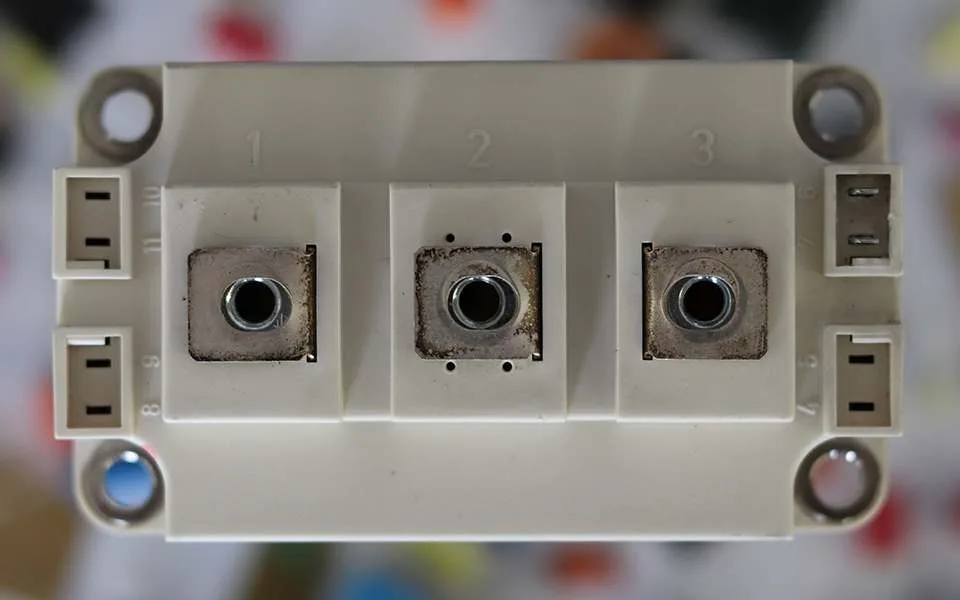
Electronic switches include MOSFETs, IGBTs and transistors, for example. They are used wherever a small current needs to control a large current.
rectifier
Diodes are referred to as rectifiers. The electrical property of diodes is that they only allow current to pass in one direction. Because of this function, they can be used to convert alternating voltage into direct voltage.
Interfaces to the frequency inverter
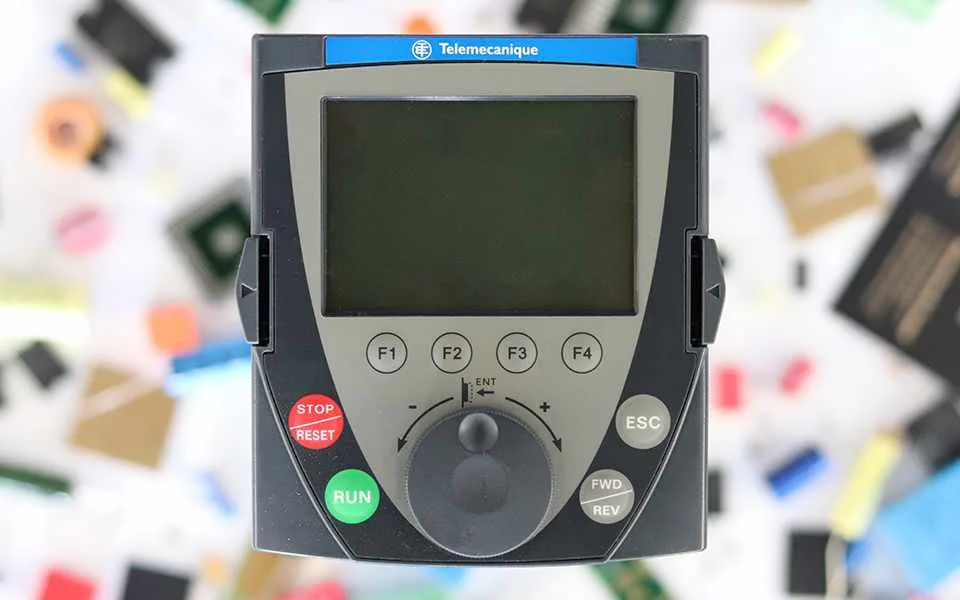
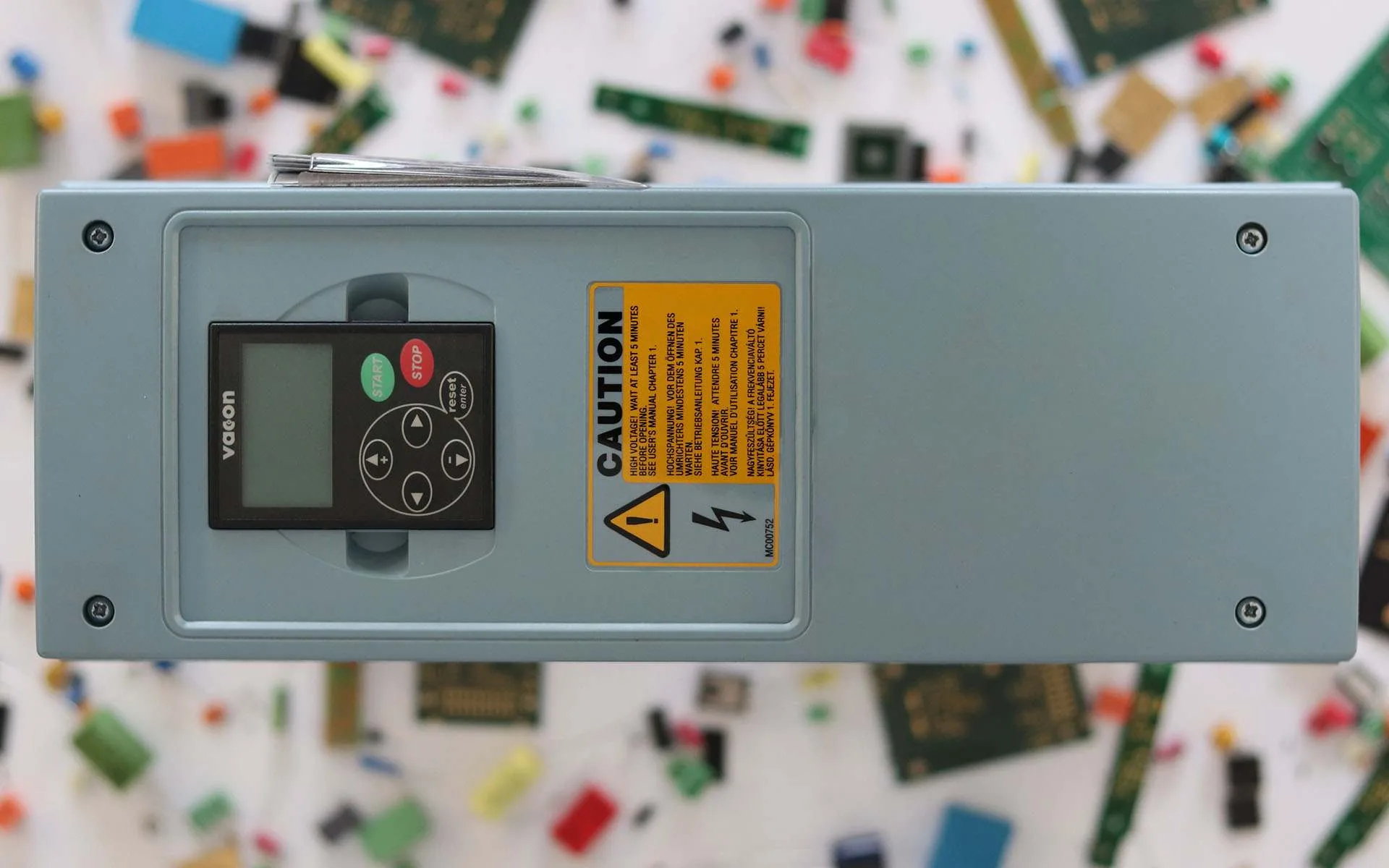
To be able to work with the frequency converter, there are various interfaces. For viewing and changing parameters, many FCs have a small display with buttons. Here, the FC can be parameterised and controlled on site. There are also usually a few analogue and digital inputs to be able to implement simple control loops directly with the FC. So that other devices can work with the frequency converter, there are various bus systems used for communication.
Applications for frequency converters
There are a great many areas of application for frequency converters. We have summarised a few of the most common ones for you.
Pump and fan application
Frequency converters are used for soft starting, air/water volume control or also for pressure control. This allows the fan/pump control to be used in many different applications. By adjusting the motor speed as required, a particularly high amount of energy can also be saved in part-load operation in these systems.
lifting and locomotion applications
Control systems for lifts, escalators, cranes and conveyor belts are always implemented using frequency converters. The frequency converter is used to achieve smooth starting, variable speeds, changing directions of rotation and controlled braking. This not only increases ride comfort, but also protects the mechanics from premature wear.
servo drive
Frequency inverters are also used for servo drives. With a sensor on the motor, the control system always knows the exact position of the motor and can position or hold it to within a few millimetres. An example of a servo drive is the XYZ control system on large CNC machines.
Compressors and refrigeration technology
Another important area of application is compressors in compressed air and air conditioning technology. The frequency converter dynamically adjusts the output to the current cooling or pressure demand and avoids energy-intensive switching cycles.
Typical frequency converter faults for repair
Due to long and heavy use, the tolerances of individual components change over time. This can reach a point where the frequency inverter no longer performs its function. In such cases, professional frequency inverter repair helps. You can find typical faults in the following section, many of which we can reliably rectify. You are welcome to obtain further information about frequency inverter repair by phone or email.
No motivation left
The display turns on and outputs error codes. The history is mostly filled with errors. The motor is completely inoperative, has no power or keeps cutting out.
No communication
The control system or visualisation can no longer communicate with the frequency inverter. The motor can usually still be controlled using the display on the frequency inverter.
No further input possible or display non-functional
The frequency converter is working normally via the external control, the display is inoperative and no longer accepts any input.
Total failure
The display is no longer showing anything, and communication with the frequency converter has also failed. In addition, the circuit breaker may trip as soon as the frequency converter is connected to the mains.